
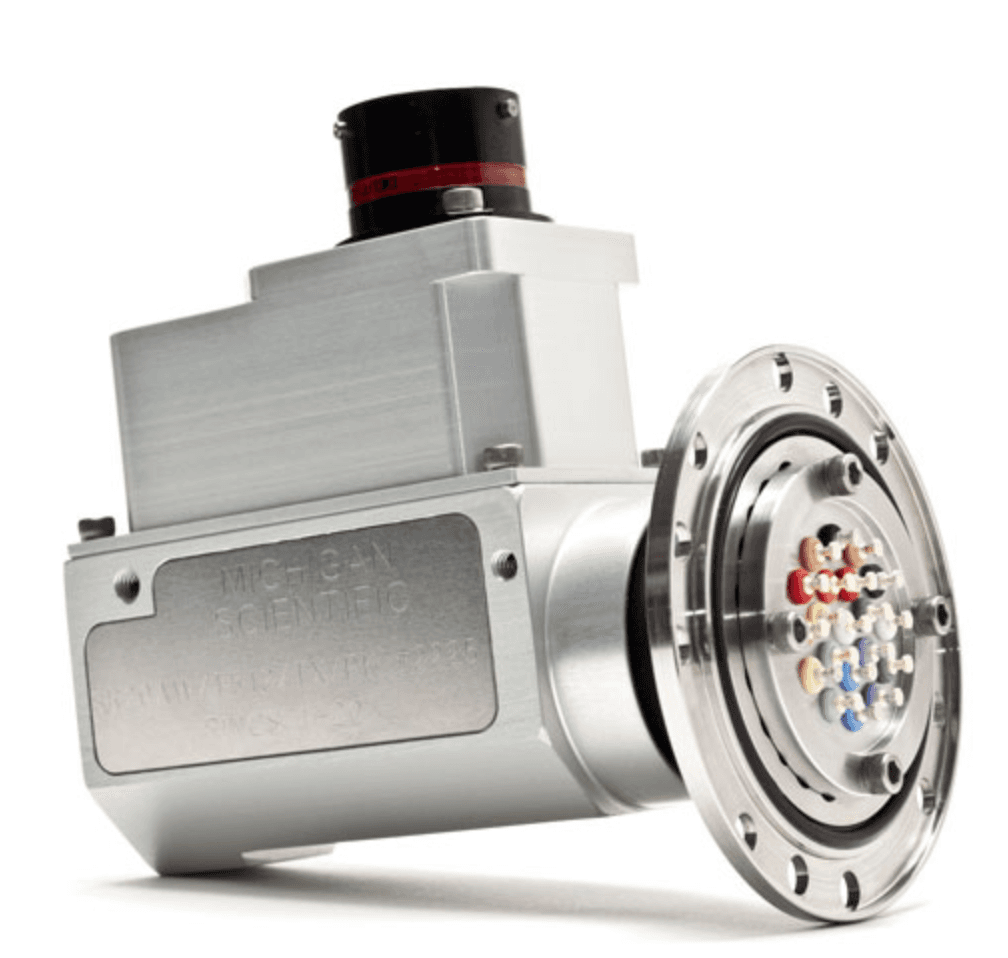
End of shaft
S-Series
The compact, cost-effective standard
4 to 10 circuits · 12,000 rpm (20,000 option)
Michigan Scientific Europe / Precision slip rings
Michigan Scientific instrumentation-quality slip rings: strain gauges, thermocouples, ICP accelerometers, RTDs and encoders — from the test bench to the instrumented vehicle.
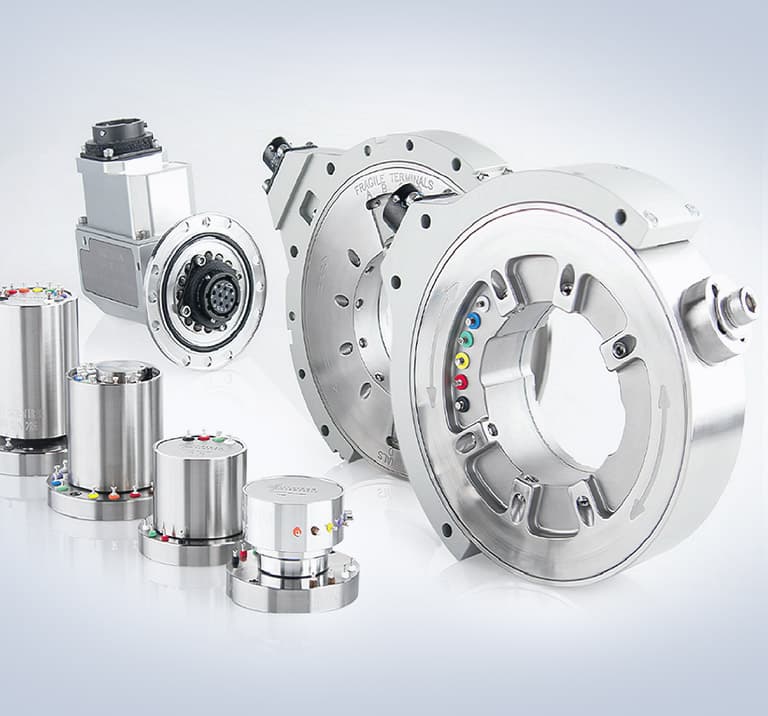
Signal integrity / 360°
4–100 circuits · up to 20,000 rpm
Our product range
Two architectures: end-of-shaft (the slip ring mounts on the shaft end) or tubular (the shaft passes through the slip ring). The right choice depends on your mechanical access and required channel count.
01 / Accessible shaft
End-of-shaft
For compact, fast integration.
02 / Non-accessible shaft
Through-bore
For continuous shafts and OEM integrations.
01 / Most common mounting
Compact, high-speed solutions that mount directly at the accessible end of an instrumented shaft.
End of shaft
The compact, cost-effective standard
4 to 10 circuits · 12,000 rpm (20,000 option)
End of shaft
High channel counts, stainless steel construction
6 to 36 circuits · up to 12,000 rpm (15,000 option)
End of shaft
Very high channel counts
45 to 60 circuits · [TO BE CONFIRMED]
02 / Through-bore mountingTubular (through-shaft)
Direct mounting on shafts ⌀ ≤ 50.8 mm
02 / Through-bore mountingTubular (through-shaft)
Shafts up to ⌀ 81.3 mm
Does your configuration go beyond standard models? Our engineers also develop dedicated slip rings, high-speed versions and OEM integrations.
Find my referenceQuick Select

Precision signal transfer
Your sensor rotates. Your acquisition stays reliable.
The principle
As soon as a sensor is mounted on a rotating part — drive shaft, wheel, spindle, rotor — its signal has to reach a stationary data acquisition system. A regular cable twists and breaks within a few revolutions: you need a rotating connection.
A slip ring solves this with continuous electrical contact between rings mounted on the shaft and stationary brushes. With instrumentation-quality precious metal contacts, this link transmits very low-level signals — strain gauge bridges, thermocouples, RTDs, ICP accelerometers, digital signals — with no delay and no distortion.
It is the simplest and most cost-effective approach for the vast majority of tests. When it does not fit (inaccessible shaft, large suspension travel), wireless telemetry or fiber optics take over — Michigan Scientific offers all three technologies.
Applications
Each use case has its own constraints: signal level, bandwidth, channel count, environment. Pick yours for a detailed guide and the right models.
 01
01Your need
Strain gauges on a shaft, propshaft or half-shaft: getting a reliable signal without stopping the rotation.
Learn more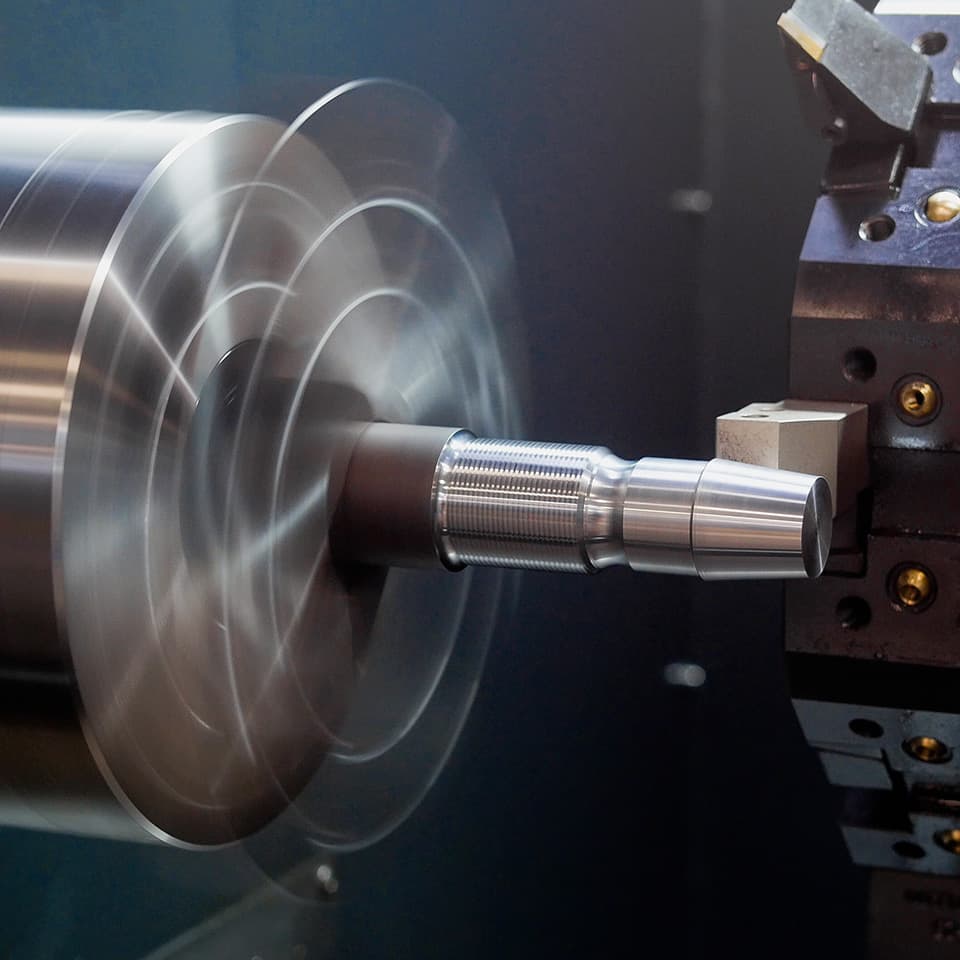 02
02Your need
Thermocouples or RTDs on a rotating component: carrying millivolt-level signals without corrupting the measurement.
Learn more 03
03Your need
ICP/IEPE accelerometers mounted on a rotating component: carrying a wideband dynamic signal without filtering it.
Learn more 04
04Your need
Gauge bridges on rotating parts: stress, bending, torsion — recovering reliable millivolt signals in rotation.
Learn moreMichigan Scientific
Michigan Scientific has been designing and manufacturing measurement systems for rotating parts for over 65 years, serving automotive, aerospace, railway and industrial test programs. PM Instrumentation provides distribution and technical support in Europe.
Precious metal rings and brushes, 0.1 Ω maximum contact noise: designed to carry millivolt-level signals, not just power.
Direct-contact transmission introduces no latency and no filtering: your dynamic measurements stay true to the physics.
Permanently lubricated bearings, dust-protected housings: mount the slip ring and focus on your test campaign.
Weatherproof versions, integrated encoders, embedded strain gauge or thermocouple amplifiers, high-speed versions, custom OEM designs.
Expert configurator
Describe your measurement need: the configurator identifies compatible references in the Michigan Scientific range.
Test & measurement
Test & measurementAutomotive
Drivelines, axles, brakes, instrumented wheels
Test & measurementAerospace
Engine test rigs, rotors, actuators
Test & measurementAgriculture
Power take-offs, drivelines, axles
 Test & measurement
Railway
Test axles and bogies
Test & measurementEnergy
Rotating machinery, test rigs
FAQ
No. Transmission happens through direct electrical contact: no delay, no bandwidth limitation. Contact resistance variation is specified at 0.1 Ω maximum on the instrumentation series (S-Series, B-Series), negligible in most measurement chains.
Bearings are permanently lubricated and no maintenance is required. Signal degradation may appear after 50 to 100 million revolutions — roughly 100,000 km on a passenger vehicle.
Yes. E60 versions add a 60 pulses-per-revolution encoder (available on B-Series and SR Series), and the SR__/PE512 series integrates a precision encoder. Useful to correlate your measurements with shaft position or speed on the same mechanical mount.
The slip ring is the simplest and most cost-effective solution when the shaft is mechanically accessible. Wireless telemetry is the answer when no mechanical link is possible (large travel, inaccessible shaft). Fiber optics addresses very severe EMI environments. Michigan Scientific offers all three technologies: the recommendation depends on your application, not on a catalogue.
Strain gauges (full, half and quarter bridge), thermocouples, RTDs, ICP/IEPE accelerometers, encoders and digital signals. CAN protocols are also supported.
Standard versions are dust-protected and operate from -40 °C to +121 °C. Weatherproof versions (B4-2W, B6-3.2W, SR__MW…) are available for outdoor testing or humid environments.
It is not mandatory, but embedded amplifiers on the rotating side (strain gauge or thermocouple) are available as options to improve signal-to-noise ratio — and are essential to eliminate thermal gradient error on thermocouple measurements.
Talk to an engineer
Describe your measurement need: an engineer will get back to you with a concrete recommendation (model, configuration, quote).
Or call us directly: +33 1 46 91 93 36