
Michigan Scientific Europe / Application guide
How to measure temperature on a rotating shaft?
Bearings, brakes, clutches, electric machine rotors: critical temperatures often sit on rotating parts. Thermocouple signals are very low level and sensitive to the slightest parasitic thermoelectric EMF: the rotating link must be flawless to avoid corrupting the measurement.
Choose the architecture
Three ways to get a temperature signal off a rotating part
Slip ring, wireless telemetry or fiber optics: Michigan Scientific offers all three. For temperature, the deciding factor is often test duration — and how parasitic thermoelectric EMF is handled.
Slip ring
Thermocouple or RTD wires run to the slip ring; the signal crosses the ring/brush interface to the stationary acquisition system.
- Continuous transmission: ideal for long endurance testing
- No battery changes, no mandatory on-shaft electronics
- Up to 36 circuits on a single assembly (SR Series)
- Spinning thermocouple amplifiers available, with cold junction compensation
- A temperature gradient between rotor and stator can bias a direct thermocouple measurement (solution: embedded amplifier, see FAQ)
- Mechanical access to the shaft required
Wireless telemetry
The thermocouple signal is digitized on the rotating part and transmitted by radio to a stationary receiver.
- No mechanical link
- Suits wheels and parts with large travel
- On-shaft power (battery or induction) to manage over the test duration
- Higher cost
- Bandwidth defined by the system
Fiber optics
Optical transmission, immune to electromagnetic interference.
- Total EMI immunity
- Relevant close to high-power electric machines
- Higher complexity and cost
- Best reserved for electrically severe environments
In real conditions
See the integration before choosing the reference.
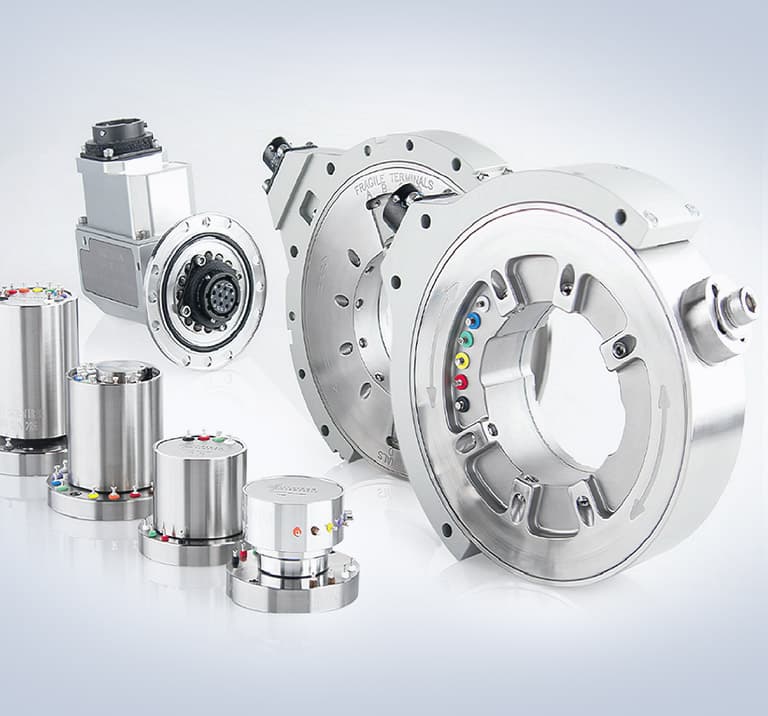
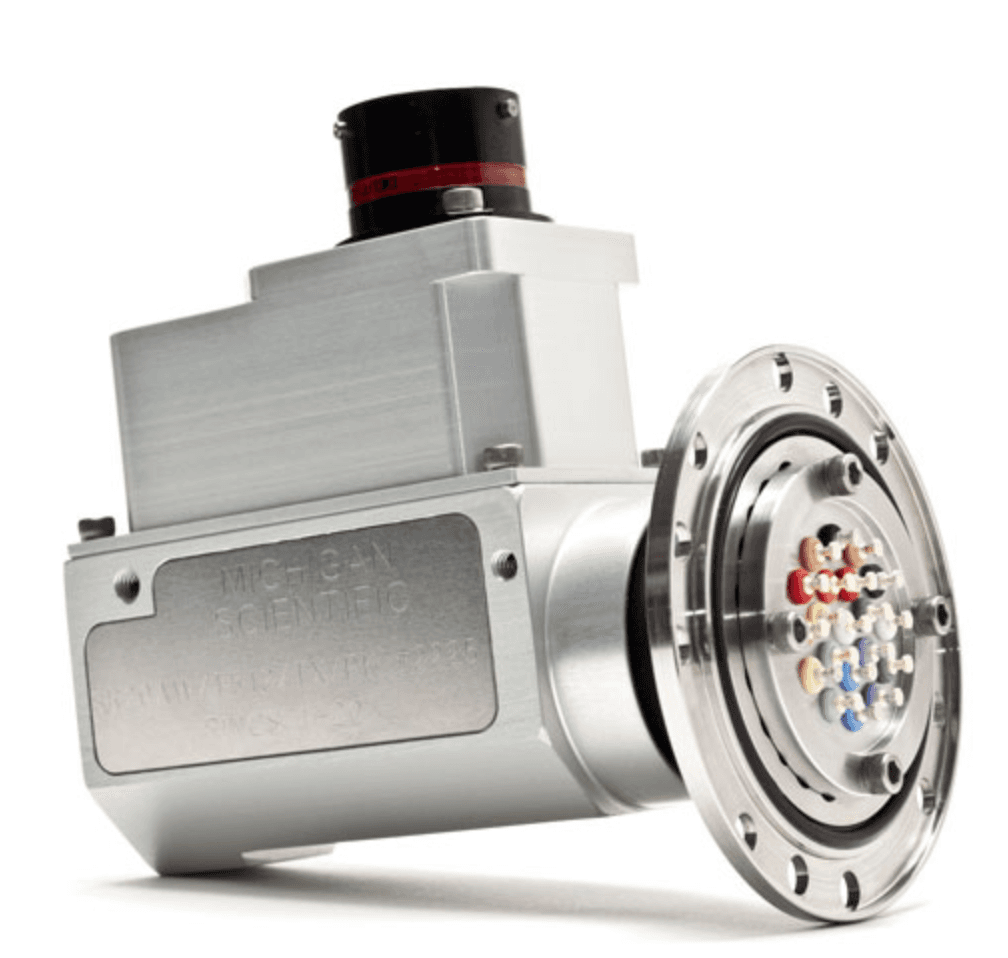
The slip ring sits between onboard instrumentation and stationary acquisition. This visual view helps validate the footprint, mounting and signal routing from the earliest design stages.
Why the slip ring suits rotating temperature measurements
The precious metal contacts of Michigan Scientific slip rings exhibit low, stable resistance — a prerequisite for carrying millivolt-level thermocouple signals. For endurance campaigns, continuous contact transmission removes any battery or radio link constraint.
One known pitfall: if thermocouple wires pass directly through the slip ring, a temperature gradient between rotor and stator can introduce a measurement error (thermoelectric effect). Michigan Scientific documents this phenomenon and offers the proven solution: spinning thermocouple amplifiers with an on-rotor cold junction reference — the slip ring then only carries an amplified signal, insensitive to the gradient.
- Compatible with thermocouples and RTDs
- Spinning TC amplifiers with on-board cold junction (S6/TC3, Short S/TC)
- Continuous operation from -40 °C to +121 °C at the slip ring
- No batteries to manage during endurance testing
Next step
Your selection, already oriented to this application.
The signal type is prefilled from this guide. Simply refine the mechanical constraints and test conditions to find the suitable references.
Going further (technical documentation)
01Does going through the slip ring bias the thermocouple measurement?
Only if a temperature gradient exists between the slip ring rotor and stator while the TC wires pass directly through it: the thermoelectric effect then introduces an error proportional to that gradient. The solution documented by Michigan Scientific: a spinning thermocouple amplifier with a cold junction reference, mounted on the rotor side. The slip ring then only carries a high-level signal, insensitive to the gradient.
02How many thermocouples on a single slip ring?
A direct thermocouple uses two circuits: an SR36M (36 circuits) therefore supports up to 18 thermocouples. With embedded amplifiers (e.g. S6/TC3: 3 amplified TCs), you optimize the number of measurement points per circuit.
03Up to what temperature does the slip ring operate?
The slip ring itself operates from -40 °C to +121 °C. The measurement point can be much hotter: only the slip ring needs to stay within its range — the thermocouple wires cover the distance.
Related use cases
Talk to an engineer
Tell us about your application
Describe your measurement need: an engineer will get back to you with a concrete recommendation (model, configuration, quote).
- Reply within 1 business day
- Validation of your measurement chain
- Matched reference, options and quote
Or call us directly: +33 1 46 91 93 36