
Michigan Scientific Europe / Application guide
How to measure vibration and acceleration on rotating parts?
NVH analysis of a driveline, rotor monitoring, unbalance characterization: sometimes the accelerometer must be mounted on the rotating part itself. ICP/IEPE sensors require both constant-current excitation and wideband signal transmission — two constraints the rotating link must satisfy simultaneously.
Choose the architecture
Three ways to transmit a vibration signal
For vibration, bandwidth is the deciding factor: a truncated or aliased spectrum invalidates the whole analysis. Here is how the three approaches compare.
Slip ring
The ICP excitation current and the sensor signal cross the same ring/brush interface, in both directions.
- Bandwidth not limited by the link: the full spectrum is preserved
- ICP excitation current passes through the slip ring — no on-shaft electronics needed
- Continuous transmission, no delay
- Mechanical access to the shaft required
- Mechanical wear over the very long term (50-100 M revolutions)
Wireless telemetry
Signal digitized on the rotating part, transmitted by radio.
- No mechanical link
- Suits cases where mounting a slip ring is impossible
- Bandwidth and sampling rate defined by the telemetry system
- On-shaft power to manage
- Higher cost
Fiber optics
Wideband optical transmission, EMI immune.
- Total EMI immunity
- Compatible with dynamic signals
- Heavier implementation
- Best reserved for severe electromagnetic environments
In real conditions
See the integration before choosing the reference.
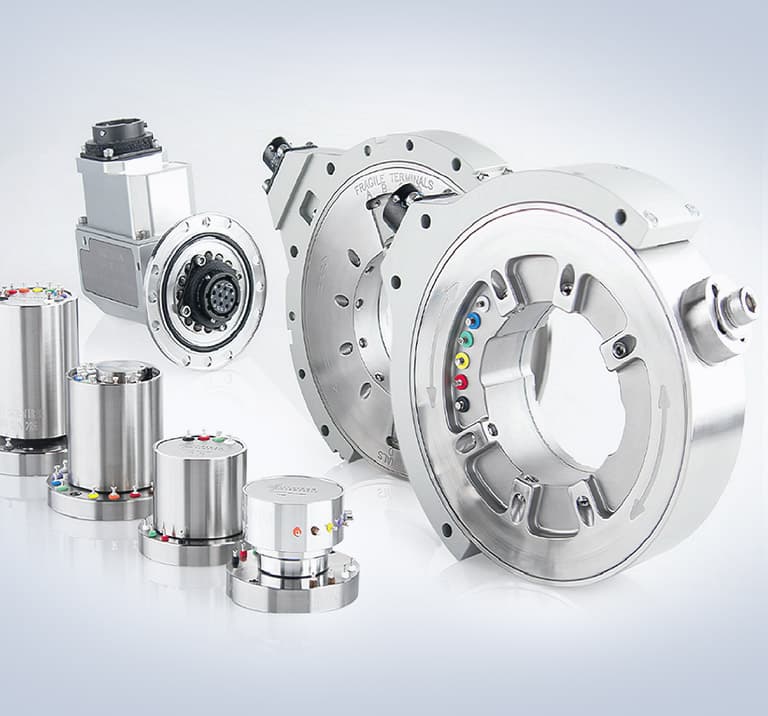
The slip ring sits between onboard instrumentation and stationary acquisition. This visual view helps validate the footprint, mounting and signal routing from the earliest design stages.
Why the slip ring suits vibration measurements
Michigan Scientific slip rings do not limit bandwidth and introduce no signal delay: the spectral content captured by the accelerometer reaches the analyzer intact. That is the prerequisite for reliable order analysis or fault diagnosis.
ICP/IEPE sensors operate with constant-current excitation superimposed on the signal: this loop crosses the slip ring with no additional electronics on the rotating side. The chain stays simple — sensor, slip ring, standard ICP conditioner.
- Compatible with ICP/IEPE accelerometers (constant-current excitation through the slip ring)
- No added bandwidth limitation
- Dynamic signal transmitted with no delay
- Up to 12,000 rpm continuous (S-Series), 20,000 as an option
Next step
Your selection, already oriented to this application.
The signal type is prefilled from this guide. Simply refine the mechanical constraints and test conditions to find the suitable references.
Going further (technical documentation)
01Is the signal bandwidth limited by the slip ring?
No. The manufacturer specifies that its slip rings do not limit bandwidth: the contact link transmits the analog signal as-is, with no intermediate conversion or sampling.
02Does the ring/brush contact add noise to the spectrum?
Contact resistance variation is specified at 0.1 Ω maximum. On an ICP output signal (volt-level, low impedance), this contribution is negligible in practice.
03Up to what rotation speed?
12,000 rpm standard on S-Series and SR Series, with options up to 20,000 rpm (S10/15K09/LHV). B-Series tubular models go up to 7,000 rpm.
Related use cases
Talk to an engineer
Tell us about your application
Describe your measurement need: an engineer will get back to you with a concrete recommendation (model, configuration, quote).
- Reply within 1 business day
- Validation of your measurement chain
- Matched reference, options and quote
Or call us directly: +33 1 46 91 93 36