
Michigan Scientific Europe / Application guide
How to measure strain (strain gauges) on a rotating shaft?
Stress analysis on a crankshaft, bending of a half-shaft, torsion of a driveline: strain gauges remain the reference. But a gauge bridge only delivers a few millivolts: every parasitic milliohm counts when crossing the rotating link.
Choose the architecture
Three ways to transmit a strain gauge signal
The comparison is close to torque measurement (which itself relies on gauges), with one nuance: stress analyses often multiply measurement points — and therefore the required channel count.
Slip ring
The bridge wires run to the slip ring; excitation and signal cross the ring/brush interface.
- Stable contact resistance (≤ 0.1 Ω): compatible with millivolt signals
- Up to 36 standard circuits (SR Series) for multi-bridge setups
- Continuous transmission, no delay, no battery
- Embedded bridge amplifiers available as options
- Mechanical access to the shaft required
- Wear after 50 to 100 million revolutions
Wireless telemetry
The bridge is conditioned and digitized on the shaft, then the signal is transmitted by radio.
- No mechanical link
- Clamp-on systems install without disassembling the driveline
- On-shaft power to manage
- Channel count and bandwidth defined by the system
- Higher cost
Fiber optics
Optical transmission of the conditioned signal, EMI immune.
- Total EMI immunity
- Higher complexity
- Best reserved for severe electromagnetic environments
In real conditions
See the integration before choosing the reference.
The slip ring sits between onboard instrumentation and stationary acquisition. This visual view helps validate the footprint, mounting and signal routing from the earliest design stages.
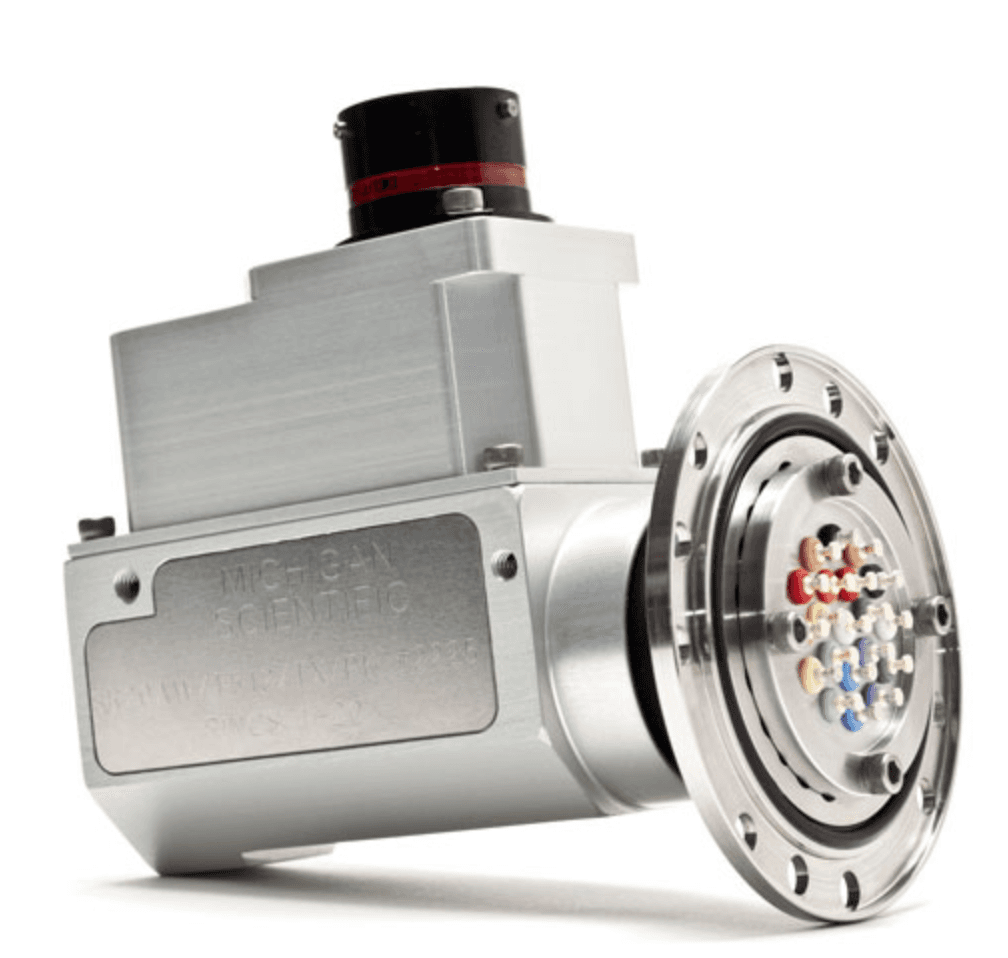
Why the slip ring suits strain gauge measurements
The precious metal rings and brushes of Michigan Scientific slip rings minimize contact resistance variation — the critical parameter for a Wheatstone bridge, where a few parasitic milliohms translate directly into measurement error. This is what separates an “instrumentation-quality” slip ring from a generic industrial one.
To further improve signal-to-noise ratio, bridge amplifiers can be embedded on the rotating side: S-Series variants S6/G (1 amplified channel) and S8/2Gx (2 channels), or the miniature AMP-SG-M1 amplifier wired between the sensor and the slip ring.
- Contact noise ≤ 0.1 Ω: compatible with full, half and quarter bridges
- Four circuits are enough for a full bridge (excitation + signal)
- Multi-bridge: up to 36 standard circuits (SR36M)
- Embedded amplifiers as options (S6/G, S8/2Gx, AMP-SG-M1)
Next step
Your selection, already oriented to this application.
The signal type is prefilled from this guide. Simply refine the mechanical constraints and test conditions to find the suitable references.
Going further (technical documentation)
01Should I amplify the signal before or after the slip ring?
Both work. On-rotor amplification (S6/G, S8/2Gx, AMP-SG-M1) improves signal-to-noise ratio since the slip ring then carries a high-level signal. With a well-wired bridge, direct transmission of the millivolt signal remains perfectly usable thanks to the ≤ 0.1 Ω contact noise.
02How many bridges on a single slip ring?
A full bridge uses 4 circuits. An S10 (10 circuits) supports 2 full bridges; an SR36M (36 circuits) up to 9. By sharing excitation between bridges you can go further — the B8-2 (8 circuits) is documented up to 3 full bridges.
03Does mounting the slip ring disturb the instrumented shaft?
S-Series end-of-shaft slip rings weigh about 111 to 119 g for 33 to 41 mm in length: the effect on shaft dynamics is generally negligible. Tubular versions clamp with set screws, with no shaft machining.
Related use cases
Talk to an engineer
Tell us about your application
Describe your measurement need: an engineer will get back to you with a concrete recommendation (model, configuration, quote).
- Reply within 1 business day
- Validation of your measurement chain
- Matched reference, options and quote
Or call us directly: +33 1 46 91 93 36